Many learners spend countless hours memorizing grammar rules, completing worksheets, and practicing isolated skills. Yet, when it comes to real conversations, they struggle to respond naturally, understand spoken English, or express their ideas clearly.
So, what’s going wrong?
Why Learning English Feels Difficult
For most learners, English feels difficult not because it is inherently complex, but because of how it is taught.
Traditional learning methods often separate language skills:
• Reading without discussion
• Writing without real context
• Listening without interaction
The result?
Knowledge without communication.
Students may understand grammar rules and vocabulary, but still find it hard to:
• Speak confidently in real situations
• Follow natural conversations
• Respond quickly and effectively
This gap exists because language is learned in isolation—while real communication never works that way.
How Real Communication Actually Works
Think about how you learned your first language.
You didn’t start with grammar books. Instead, you:
• Listen to people around you
• Observed meaning through context
• Responded naturally over time
Real communication is a combination of multiple skills happening at once. You:
• Listen and understand
• Process information
• Respond appropriately
• Express ideas clearly
This is exactly how English should be learned.
What Is the Integrated Skills Approach?
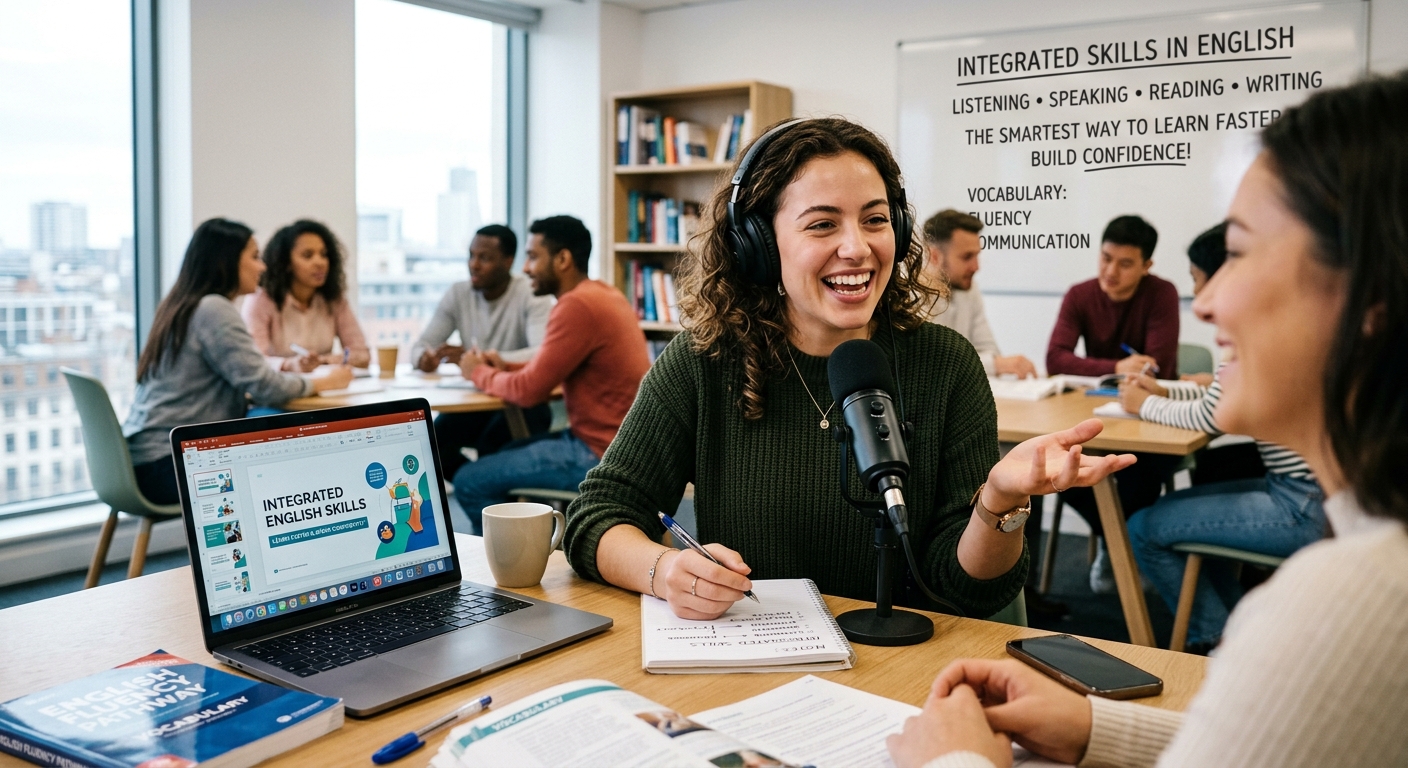
The integrated skills approach focuses on learning English by combining:
Listening + Speaking + Reading + Writing
Instead of practicing each skill separately, learners use them together—just like in real life.
For example:
• You read a passage, discuss it, and then write your opinion
• You listen to a conversation and respond naturally
As Brown (2001) highlights, real language use involves the integration of multiple skills along with thinking and interaction. This makes integrated learning essential for meaningful communication.
Why Modern English Exams Use Integrated Skills
International exams are designed to reflect real-world communication. That’s why they test multiple skills together.
IELTS Academic
• Reading + Writing: Analyze data and write reports
• Listening + Reading: Understand and respond to information
PTE Academic
• Reading + Speaking: Read aloud, describe images
• Listening + Speaking: Repeat sentences, retell lectures
• Listening + Writing: Write from dictation
TOEFL iBT
• Integrated Speaking: Read, listen, and respond
• Integrated Writing: Compare reading and lecture content
Success in these exams depends on your ability to use skills together; not separately.
Why the Integrated Approach Works
The integrated skills approach delivers real, measurable results:
1. Improves Real Communication
You practice language the way it is actually used in everyday life.
2. Builds Fluency Faster
Your brain learns to process and respond naturally, improving speed and confidence.
3. Connects Language Naturally
Vocabulary, grammar, and meaning develop together in context; not in isolation.
4. Boosts Confidence
Regular, realistic practice reduces hesitation and fear of speaking.
5. Makes Learning Engaging
Interactive tasks increase motivation and participation.
How It Works in Practice
The approach follows a simple and powerful cycle:
Input → Processing → Output
• Input: Read or listen to information
• Processing: Understand, analyze, and discuss
• Output: Speak or write your response
Example Activity:
1. Watch a short English video
2. Note key ideas while listening
3. Discuss the topic or record your response
4. Write a short summary
This single activity develops multiple skills at once—making learning faster and more effective.
Real-Life Benefits
Integrated skills training prepares you for:
Workplace Communication
• Understanding instructions
• Writing emails and reports
• Speaking clearly in meetings
Academic Success
• Reading and analyzing study materials
• Participating in discussions
• Completing written assignments
Everyday Communication
• Engaging in conversations
• Understanding spoken English
• Expressing ideas confidently
Why This Approach Changes Everything
The difference is simple:
Traditional learning helps you understand English
Integrated learning helps you use English
And that’s what true fluency is.
Start Learning the Smart Way
At Kaartdijin Oasis, our English programs are designed around real-world communication and international exam formats like IELTS and PTE.
With structured guidance, practical activities, and expert training, you don’t just learn English—you learn how to use it confidently in real situations.
Ready to improve your fluency faster?
Join a program that focuses on real communication, not just theory.
Take the first step toward confident English today.